Showing posts with label Ramen Riders. Show all posts

Thursday, December 31, 2020

らあめん厨房どる屋 (Doruya in Utsunomiya, Tochigi Prefecture)

らあめん厨房どる屋


Welcome to Utsunomiya. This major city in Tochigi Prefecture is known for gyoza, but they also have a few notable ramen shops as well. Head over to city hall, take care of any paperwork you might have, and get a bowl at Doruya (the shop is basically next door).


Doruya's specialty is Sea bream salt butter ramen using high-quality French butter. Definitely a unique spot.


Everything on the menu is made with dried tai (鯛) fish from Shimane Prefecture.


The menu looks a bit complex, but just order the Tai Shio Bata Ramen (鯛塩バターらーめん). The menu has a different column for different kinds of chashu. Go for loin (焼豚), rib (ばら焼豚), or cheek (ほっぺた焼豚).

The butter, for you gourmands out there, is the Échiré brand from France. Loved by pastry chefs the world over, it's now available in your ramen. Échiré has, according to the internet, a unique flavor from their wooden butter churns. In Japan, it is very expensive. If you live in Tokyo you can visit their shop near Tokyo Station to try some for yourself.


The shop also offers an array of limited seafood bowls, like mitten crab (藻屑蟹) in winter and ayu (鮎) in summer.


The master, Ochiai-san (落合) opened the shop in 1996. He's spent time overseas in Australia, so feel free to speak in English. Doruya also does some neat outreach programs for local elementary school students. Using local fish he helps the kids create their own homemade ramen. How cool is that!

Some of the kid's ramen looked great. Unfortunately, they don't serve it to customers. I was some rainbow trout ramen!


Official site here.


Sunday, December 27, 2020

ふる川 (Furukawa in Mito, Ibaraki Prefecture)

ふる川


Furukawa! This shop isn't so easy to get to. There aren't any train stations nearby, though it looks like a 30-minute bus ride from Mito Station will get you there. Mito is a nice city with some nice ramen shops, so you might be out here for some noodles as it is, but these accessible-by-bus shops are rough. I rode my motorcycle.


The master takes inspiration from French cooking. You might even call the ramen here consome-style. A light soup made from mussels, scallops, and shrimp. The menu is large, with shio, shoyu, and tantanmen as some appealing choices.


But the kakesoba (かけそば) is something special. Just soup and noodles. No toppings to distract from that pure soup.


A simple bowl, perfect for a day of riding the motorcycle around to different shops in Ibaraki and Tochigi. 


Really beautiful stuff. Soup full of ocean umami and homemade noodles. The master worked in the world of French dining before opening his ramen shop.


I should note that since 2020 Fukukawa seems to be dismissing any offers from media to be featured in their magazine pages. They are constantly given top-level status on popular websites and in ramen magazines. I should also note that is a lunch-only spot that opens at either nine or ten in the morning. Though I was early, there was no one waiting, though this was in the weeks following the semi-shutdown in Tokyo for the COVID-19 pandemic and I think most people were avoiding travel.


Thursday, December 24, 2020

松五郎 (Matsugoro in Mito, Ibaraki Prefecture)

 スタミナラーメン松五郎


Have you tried all of Japan's local styles? How about Ibaraki's semi-famous stamina ramen? Thick noodles topped with a Chinese ankake (あんかけ) made from carrots, cabbage, pumpkin, and liver. As the name suggests, it is meant to give you extra stamina.


There are around 40 stamina ramen shops in Ibaraki Prefecture, with many in Hitachinaka City (ひたちなか市) just next to the Prefecture's main city Mito. The shop Daishin (手打らーめん 大進) created the stuff in 1970, but the master Junichi Nagai-san (長井順一さん) eventually went on to open Matsugoro just over the border in Mito.


The menu is huge but simple. A feature of stamina ramen is the ability to order your ramen double, triple, up to six times the normal size (麺玉6ヶ). They also offer it two ways, hot or cold.


I went with the standard and it was plenty. The ankake sauce is a bit like Chinese hot and sour dishes. A bit of sweet, a bit of sour, and a bit of spice.


Apart from stamina ramen, there are four other official styles of ramen in Ibaraki Prefecture. 

Mito Clan ramen (水戸藩らーめん) is a recreation of ramen introduced to the Mito branch of the Tokugawa family in Edo times. Little is known except that lotus root flour was used.

Shimodate-style (下館) is closely connected with the old school shops from Sano in Tochigi and Kitakata in Fukushima.

Northern shops serve tofu miso ramen, another Ibaraki specialty.

Of course, most of these "original" styles are just marketing from the prefectural tourism board.

The final style isn't really a style, more of a concept. Ibaraki has an abundance of fresh ingredients and is sometimes called Kanto's kitchen (関東の台所). Okuji shamo (奥久慈しゃも) and Tsukuba shamo (つくばしゃも) are two prized chicken breeds. Mimei pork (美明豚) is another local specialty. Local soy sauce, local clams, and local sardines are also prized by ramen chefs. For those trying to learn everything about rame culture in Japan, the tourism board calls this style Ibaraki Sozai Ramen (いばらき素材らーめん).


To be honest, it's all a bit much and up for debate (albeit a very boring debate). Stamina ramen, though, is a definite Ibaraki creation.


Be sure to say hello to the swans if you visit Mito!


Sunday, December 20, 2020

喜元門 本店 (Kigenmon in Tsukuba, Ibaraki Prefecture)

 喜元門 本店


One of the highest-ranked shops in Ibaraki Prefecture is Kigenmon. Not only did Ramen Walker give them "legend" status, but the Tabelog gave them a spot on their best 100 ramen shops in East Japan. They have a decent 90/100 rating on the Ramen Databank as well. I was surprised, this bowl fell flat for me.


Spring in Japan is a wonderful time for flowers.


The menu at Kigenmon is deep, with about a dozen different styles. I asked what they recommend and they gave me the vague answer, "Customers who like thick ramen get the thicker stuff and customers who like lighter ramen get the lighter stuff." Not really the right answer for me. I followed up with an inquiry about which item is the most popular, but was met with more of the same.


Thick fish broth (濃厚魚出汁) ramen. In doing my post-slurp research, I should have ordered the Shinku soba (真空そば). Shinku means vacuum. The soup is cooked in a vacuum pot to maximize flavors somehow.


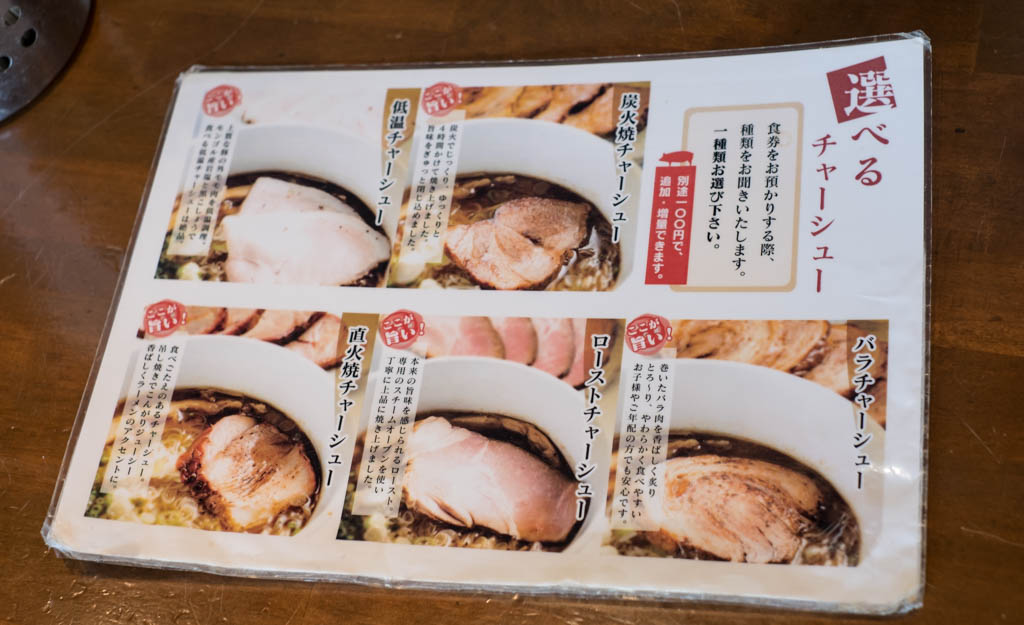
You can also choose from four kinds of chashu. 炭焼き for charcoal grilled. バラ巻き is a big fatty rolled piece. 直火焼き cooked over an open flame. 低温調理 is the sous vide we all know and love.


Plenty of food magazines, all praising the place.

The shop is fairly convenient, with three or four branches in the area. If you go, get the correct bowl and also get every chashu topping. The pork was good.


Official site here.


<iframe src="https://www.google.com/maps/embed?pb=!1m18!1m12!1m3!1d1612.2108570883238!2d140.08077976765094!3d36.083206711142864!2m3!1f0!2f0!3f0!3m2!1i1024!2i768!4f13.1!3m3!1m2!1s0x60220b95932d7a6d%3A0x8a39895098efa1fe!2z5Zac5YWD6ZaAIOacrOW6lw!5e0!3m2!1sen!2sjp!4v1604283955454!5m2!1sen!2sjp" width="600" height="450" frameborder="0" style="border:0;" allowfullscreen="" aria-hidden="false" tabindex="0"></iframe>

Thursday, December 17, 2020

鬼者語 (Onimonogatari in Tsukuba, Ibaraki)

 つくばらーめん 鬼者語


I dusted off the motorcycle after a winter of very little riding, replaced the battery, and set out for a few days in Ibaraki and Tochigi, the prefectures just to the northeast of Tokyo. There are quite a few highly ranked shops in the area, and most of these are kind of a pain to get to with public transportation. A motorcycle or car is a good call.


Onimonogatari, which means tale of the demon, is one of those highly ranked shops. While many shops in Japan are highly ranked and delicious, only a handful are as unique as this one. The menu, for example, is kind of intense. I first noticed the limited daily menu. Onimonogatari black ramen, Amakusa (天草) tsukemen, lamb and seasonal vegetable something, and today's jibie. Jibie (ジビエ) is taken from the French word for wild game. Deer, boar, bear, who knows what they will have on the menu that day.


The regular menu has three choices. Tori to Mizu (鶏と水) is chicken ramen. Mizu to Niboshi (水と煮干) adds umami from dried fish. Tsukemen, called tsukesoba here, is the third choice. I went with the chicken. This was a seriously tough decision. Those limited bowls looked like winners, but since it was my first time I wanted to try the standard bowl.


A solid choice. I love the lone brussel sprout on top.

Speaking honestly, I've had so many of these high-quality chicken shoyu ramen bowls in the last year that I kind of wish I tried the off-the-wall options. Yes, this bowl was a killer. Yes, you should probably get it. Yes, I want to go back around once a week.


Once I delved into this bowl, though, I was happy to have ordered it. It features Amakusa Daio (天草大王) chicken from Kyushu. This breed was prized for their meat, but due to a low egg count, became nearly extinct during the Showa Era (1926-1989). Thanks to science, they were able to keep it going. These monster chicken grow to around seven kilograms. Amakusa Daio is known for its thick thighs and meaty breasts. Hey, I'm just reading from the PR pamphlet!


I already explained how many choices were on the menu. How about more? When your noodles are done, put in an order for a special kaedama. Extra noodles with a kick. Japanese flavor, boar and duck blood, Genovese basil sauce, or green curry. For the adventurous, there is a Genovese with cheese flambee. 


Again, I wanted to branch out but was saving myself for some other shops.


This shop could only be created by an equally interesting owner. Okubo-san is a former pro boxer. One of his sponsors was a ramen shop, and he became obsessed with the stuff. Eventually, he managed to open Onimonogatari.


Check their Twitter for the latest specials.


<iframe src="https://www.google.com/maps/embed?pb=!1m18!1m12!1m3!1d3226.0088902074936!2d140.09875591622136!3d36.044488917569346!2m3!1f0!2f0!3f0!3m2!1i1024!2i768!4f13.1!3m3!1m2!1s0x60220b55fff52f99%3A0xf2b90cd114a206d!2z44Gk44GP44Gw44KJ44O844KB44KTIOmsvOiAheiqng!5e0!3m2!1sen!2sjp!4v1604283416840!5m2!1sen!2sjp" width="600" height="450" frameborder="0" style="border:0;" allowfullscreen="" aria-hidden="false" tabindex="0"></iframe>

Monday, August 17, 2020

Furari in Beppu, Oita Prefecture

Furari

Furari is consistenly ranked at the top of Oita ramen shops. They use Miyazaki pork cooked daily to make a frothy style tonkotsu ramen as well as their tantanmen. Noodles are made inhouse and resemble pasta. Tare is made from Hyogo soy sauce.

One of my last bowls in Kyushu in 2019 was at Furari. Of the seven prefectures in Kyushu, Oita is the least known for noodle culture. Their tourism campaigns always focus on onsen hot springs.

Furari is located on the north side of Beppu, on a hill overlooking steam vents and small onsen resorts. Keep in mind that all the onsen are in the Beppu area. If you stay down near Oita Station, you'll need to make your way up here via slow train.

Furari = Ferrari?

Fantastic stuff. Like many tantanmen bowls in Japan, it isn't too spicy, and the spice that is there is mellowed out by the creamy tonkotsu soup.


Official site here.


Thursday, August 13, 2020

丸星ラーメン (Maruboshi in Kurume, Fukuoka Prefecture)

丸星中華そばセンター 本店

A ramen truck-stop open 24 hours a day since 1958. This is the stuff of legends. This is Maruboshi.

Maruboshi lies along National Route 3 in the central city of Kurume. An hour south of Hakata and two hours north of Kumamoto make this a common stop along the transport corridor of Kyushu. Maruboshi's parking lot is about 20 times larger than the shop itself, which is already quite massive with a whopping 95 seats. There were six or seven big-rigs parked in the big-rig-only section.


Photos from the decades adorn the walls. So many smiling faces.


The ramen here isn't for everyone, but it is perfect for me. You won't find tare made from specialty soy sauce sourced from the mountains of Wakayama[citation needed]. There is probably a mountain of Ajinomoto MSG in the final product[citation needed]. There are no fancy toppings and the shop has definitely never seen a truffle[citation needed]. It's a different kind of kodawari.


Bowls are only 450 yen, up from 400 in the past. Historically, Kyushu has been the home of budget ramen, with yatai food stalls and brick-and-mortar shops alike rarely breaking 500 yen.


Maido arigatogozaimasu. Thank you every time. Maruboshi is possibly a though one to make it to, and there are other shops in Kurume to hit up, but I really think you should try. This is ramen roots, the kind of place that shaped the ramen landscape into what it is today.