Thursday, January 31, 2019

鯛らーめん 麺屋 ま石 (Maishi in Ginza)

鯛らーめん 麺屋 ま石


You all know about Kagari in Ginza. The toripaitan shop became one of Tokyo's most popular shops in the matter of a few years. Lines went from 30 minutes to over two hours. It was insane. Then they closed and moved a few blocks away. It makes sense for someone to take over the old spot.


Maishi took on the challenge. Located in a nondescript alley a stone's throw from the flagship Apple Store, the shop would be very hard to find if it weren't for a line. While Kagari had that line thing locked down, Maishi hasn't really found the same success. When I went, I walked right in.


That's a pretty bowl!

The base bowl is a tai ramen for 1000 yen. A few shops in Tokyo have started using seabream for the light ocean taste.


Other choices are that tai ramen topped with 桜海老, 帆立, or 牡蠣. Tiny pink shrimp, scallops, or oysters.


Everyone comes for the 雲丹. Sea urchin is big on the food porn scene and topping your ramen with three different kinds is a quick way to get a lot of interest.


A decent bowl that is certainly photogenic. Personally, though, I prefer my uni on rice.

I think the problem here is that their base bowl is quite nice, but most people will opt for the 2500 yen ($23 USD) uni one. It is too much to pay for ramen, and no one will want to return. Uni on ramen is often a 限定 (limited) offering at other shops and only served on special occasions.

Just my two cents.


Monday, January 28, 2019

中華蕎麦うゑず (Uwezu in Yamanashi Prefecture)

中華蕎麦うゑず


Most ramen heads know about Tomita. So much so that in 2018 the documentary Ramen Heads debuted in arthouse cinemas around the world. I saw it the second week it was out in a theater with about a dozen people. Luckily, the reception on streaming services has been much better, and Tomita has become a household ramen name.


Uewza is part of the Tomita family. Located about an hour outside of Tokyo by car, it is a nice stop on the way to Nagano. If you aren't driving, this one probably isn't for you.


Or maybe it is. This is everything about tonkotsu gyokai that makes it oh so wonderful.


Handmade noodles, wheaty and cut thick. A combination of low temperature cooked and grilled chashu.


Soup to die for.

It looks badass, more of a pork sauce than a soup, but then you taste faint yuzu flavors and notice the balance of salty and umami. This is really amazing stuff.


The wait wasn't too bad. Just don't expect it to be empty. Even though this is in the middle of the sparsely populated countryside, said countryside's residents all have cars, and driving long distances is no problem.


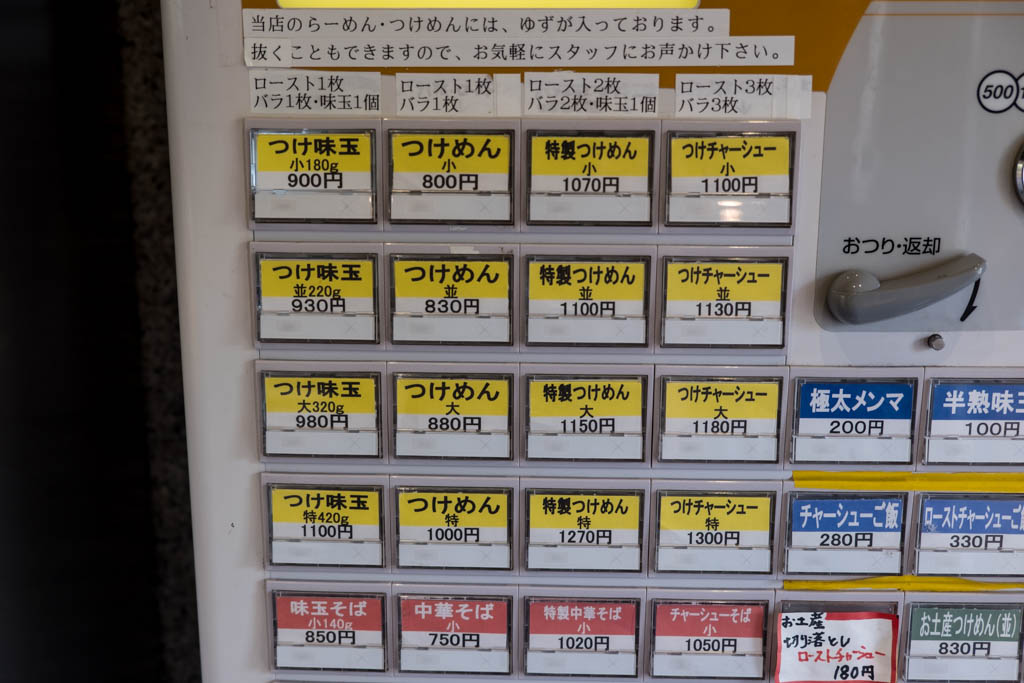
The handmade noodles really are tops. While the ticket machine looks massive, the options are mostly based on how many grams of noodles you want. Small is 180 grams all the way up to the XL at 420 grams. To put it in perspective, the average ramen in soup is less than 150 grams.


Slurp up!


Thursday, January 24, 2019

龍朋 (Ryuho in Kagurazaka)

龍朋


Old school hiyashichuka. Hiyashi (冷やし) means cool (as in temperature, not social status), and many shops do a cool noodle dish in the summer in Japan.


This wasn't just any summer. Japan saw record temperatures in 2018. The day I cycled over to Ryuho, located in the trendy Kagurazaka neighborhood, temperatures were close to 40 degrees Celcius. By the time I arrived (it takes me about 15 minutes at a fast pace) I was suffering.


Cold ramen to the rescue. This is the style that started it all in Japan. Cold ramen noodles served with a vinegary sauce. Topped with cold chashu and julienned cucumber. Thick strips of scrambled egg pancake are just sweet enough to make a dish that hits all five tastes.

High-end Chinese restaurants in Tokyo will often top this with fancy toppings, but Ryuho keeps it simple.


Amazing. I'm being humble, but I was actually suffering a little exhaustion. I hadn't hydrated enough in the morning, and a 15-minute cycle adventure in the sun was a very bad idea.

On a non-ramen note, please consider that Japan between July and September has been unbearable in recent years. 


These old school chuka spots often serve half servings of fried rice. Go for it!


Tokyo Time Out has a nice list of cold ramen shops. Check it here.