Thursday, September 17, 2020

New Years Ramen at Nagi


ラーメン凪


Every year for the past four or five, Nagi has been one of a handful of ramen shops in Tokyo to do New Years' specials. To bring in 2020, they did three different bowls over three days. Uni ramen, niboshi ramen, and Nishio's ramen.


I didn't make it on the first, so their special niboshi ramen would have to be my first of the year.

Copious amounts of Nagasaki niboshi. Nagi is famous in Japan for their heavy niboshi ramen. While this has been a hit in Japan, their overseas operations found fans with tonkotsu ramen. Interesting how that worked out.

I love these New Years' bowls for two reasons. First of all, this shop isn't so far from my home. I can be there in less than five minutes if I speed on my bicycle. The other reason is that I always run into the usual gang of Japan's ramen nerds. Most people take the first few days of the year off to lounge around the house. With only a couple ramen shops open, they all tend to come here for a bowl.

The niboshi ramen was great, made with some premium ingredients and a side of dried root vegetables with mountain wasabi.

But the real winner (every year?) is the Nishio Chukasoba.


I used to visit Nishio's shop about once a week back in the day (my original blog post was in January 2010). Since then he closed up shop to focus on the expansion of the Nagi group both within Japan and overseas. On one hand, I'm happy for one of my favorite ramen shops to succeed in such a way, but on the other, it sucks that I can't have this bowl more often. Heavily seasoned roast chashu, sprouted moyashi ben sprouts, and a special noodle made with a bit of cornflour. 


Since these are special bowls, the choice of ingredients is on the premium side. Ingredients from Akita, Kumamoto, Aomori, Iwate, Aichi, Kagoshima, Hokkaido, Tottori, Nagano, Fukuoka, and Kagawa. It's literally half of Japan in a bowl.

See you again in 2021!


Official site here.


<iframe src="https://www.google.com/maps/embed?pb=!1m18!1m12!1m3!1d202.5176917497035!2d139.6963891097118!3d35.69465121217324!2m3!1f0!2f0!3f0!3m2!1i1024!2i768!4f13.1!3m3!1m2!1s0x60188d5cc236d4ef%3A0x83ae3f10901af39d!2z5Yeq5Zyw542E!5e0!3m2!1sen!2sjp!4v1597914869508!5m2!1sen!2sjp" width="600" height="450" frameborder="0" style="border:0;" allowfullscreen="" aria-hidden="false" tabindex="0"></iframe>

Monday, September 14, 2020

Japanese Soba Noodles蔦 (Tsuta in Yoyogi-Uehara, Tokyo)

Japanese Soba Noodles蔦

"The truffle is not a positive aphrodisiac, but it can upon occasion make women more tender and men more apt to love."

- Jean Anthelme Brillat-Savarin (1852) The Physiology of Taste

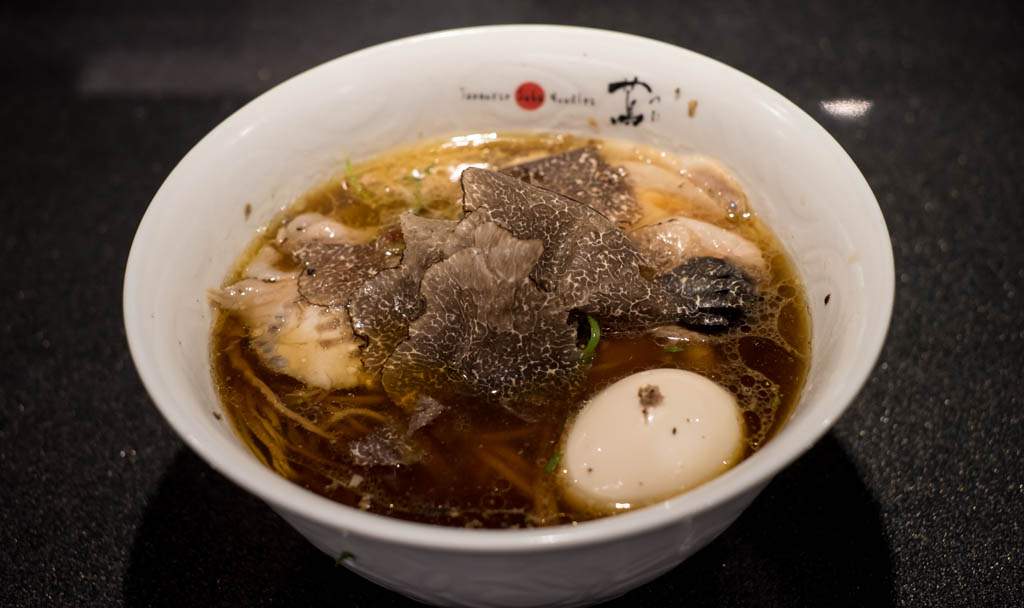
Tsuta, the first ramen restaurant in Japan to receive a coveted Michelin star is back in a new location. The menu still features truffle oil-infused shoyu ramen, as well as a few other styles. The new spot is slightly larger to deal with the insane amount of tourists they expected to receive during the now-canceled Tokyo 2020 Olympics. It's also in the much more desirable Yoyogi-Uehara, just a short walk from Yoyogi Park and Shibuya.

Please note that I came during their soft open, so things will be different when you come. I lined up for an hour, but there may be a different reservation system in place when you come.

The menu could be different as well. Chef Onishi-san, like most new-school ramen chefs, is constantly tweaking his recipes and sometimes even adding completely new items to the menu. He also frequently makes limited bowls, so check their website if you are into that sort of thing.

The noodles, though, will probably remain made in house.

Despite the meteoric rise to ramen fame, Tsuta makes a stellar bowl. They pretty much made truffle ramen a thing, and a slew of other shops started putting cheap truffle oil into their soups for a chance at some love from Michelin. It isn't lost on me that the third shop to receive a Michelin Star, Hototogisu, also uses truffles.

Yes, I ordered the shoyu ramen topped with extra shaved truffles. Each style of ramen comes with this option at a rather high cost. Is it worth it? Truffles are purely aromatic, and the amount they put in the standard bowl has almost the exact same qualities as the premium one, at a cost of almost 2000 yen less.

Of course, fresh truffles are different than truffle-infused products like oils, sauces, and butters. I recently read an expose on the shady side of Italy's truffle word called The Truffle Underground.


It paints a bleak image of this industry. I don't want to imply that anything used here is inauthentic, but many truffle products are made without any truffles at all. Pharmaceutical chemicals like bis(methylthio) methane are labeled as truffle aroma, as are boiled down bovine spines.

A paltry 2000 yen for fresh truffles isn't looking so bad now.


Maybe 2000 yen isn't a big deal, or maybe you want to do it for the Gram. Either way, you are getting their phenomenal soup.

Tsuta has always used ultra-premium ingredients. Top-level, expensive chicken from Aomori and konbu from Hokkaido. Specifically, Aomori Shamo chicken (青森シャモロック), massive Amakusa Daio chicken (天草大王), meaty Kuroiwa chicken (黒岩土鶏), and everyone's favorite Nagoya Cochin chicken (名古屋コーチン).

I crushed the ramen at this new spot with fervor.

Actually, Tsuta was one of my favorite shops back in the day. I worked in the area of their old shop at a girl's high school, a job that I really didn't have my heart in at times. After a stressful day, I would walk back towards Sugamo Station and wait in the modest 30-minute line for a bowl. When they received the Michelin Star I went once more, skipped to the front of the 2-hour line to offer my congratulations, and went home without eating. I went back once to film one of my most popular YouTube videos ever, but that was it for Tsuta and me. 

The new spot is a 5-minute bicycle ride from my home, so I'll probably roll by now and then. I hear, even during popular tourism seasons, they don't have a line in the evening. 

Welcome to the Wonderful World.

Official site here. Onishi-san's blog is here.


Thursday, September 10, 2020

らぁ麺 紫陽花 (Ajisai in Nagoya, Aichi Prefecture)

らぁ麺 紫陽花

Ajisai is considered one of the top slurps in Nagoya. Refined ramen is all the rage in recent years, with every city having a popular shop like this. 

What does refined mean in the world of ramen? Ingredients sourced from top spots around Japan. No store-bought MSG. All of the umami in this one comes from the kombu and dried fish. And, unfortunately, refined ramen usually creates massive lines.

Homemade noodles as well.

The menu at Ajisai is heavy on the shoyu. Shoyu ramen, shoyu tsukemen, and a niboshi ramen that (I assume) uses a shoyu tare. They also offer spicy tantanmen. Is the shoyu ramen is the one to get? Tantanmen at shops like this is usually excellent. See those stickers on the ticket machine?

Hash Royal is an absolute beast of a ramen hunter. He seems to know every shop in the country, and visits around 600 a year. I quickly sent him a message asking whether I should go with shoyu or tantanem. He replied in about six seconds.

The soy sauce blend uses mainly Yugeta shoyu (弓削多醤油) from Saitama. This nama shoyu is a bit on the sweet side. Homemade noodles using flour from Bifunsai in Hokkaido (美粉彩 春よ恋). Gorgeous pork from Yamagata.


Meats are all cooked low temperature-style. Tender.

Ajisai hit the spot. It hit is so well that I had to make another order.

One tantanmen, please.

Also excellent. Japanese tantanmen uses the shop's umami-rich broth and adds both hot and numbing spices. It's fusion food in a sense.

Noodles are a specialty here and the tantanmen uses thinner ones.

Open since 2015.

Ramen Walker (Japanese) page here.